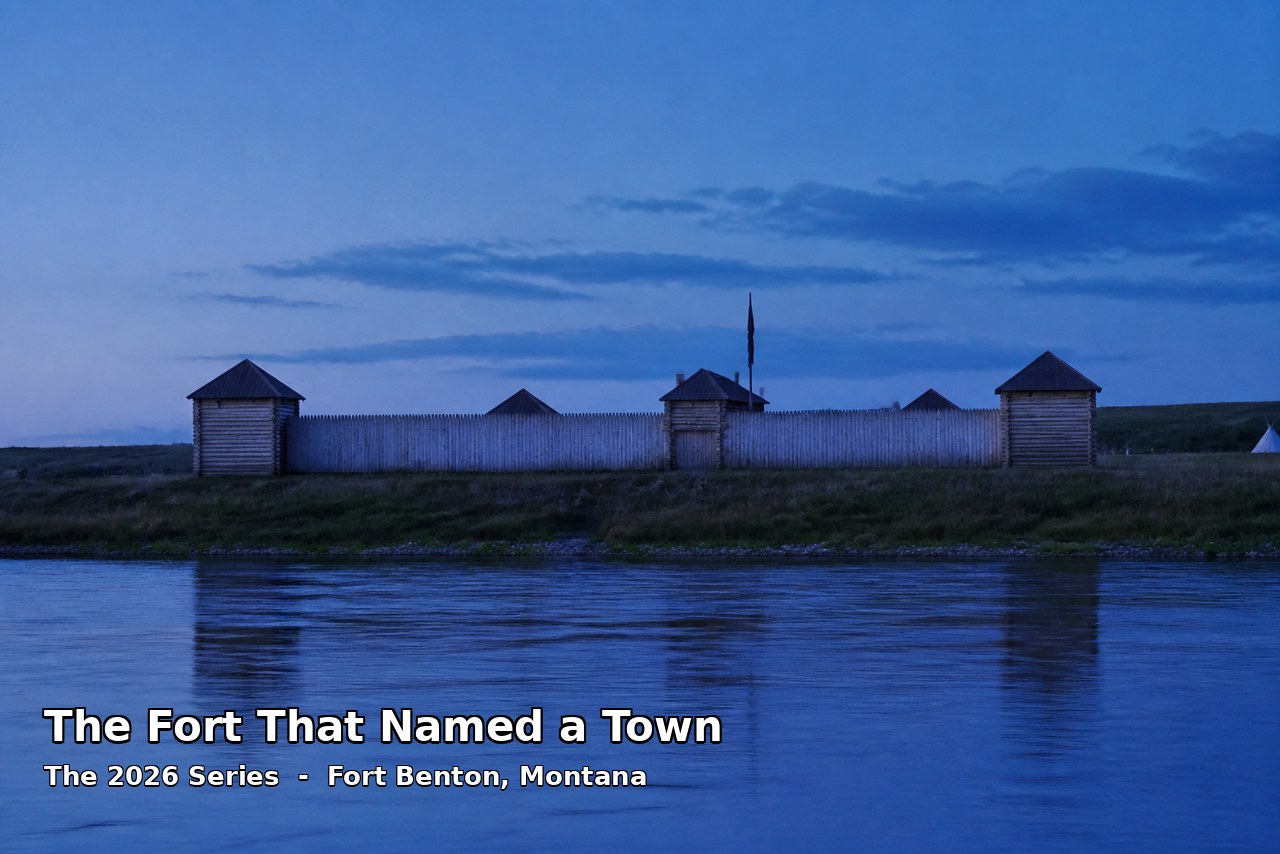
The Fort That Named a Town: Old Fort Benton
Next Door to 1800
We finished at the Museum of the Upper Missouri, walked out the door, and - we are not exaggerating here - the next museum was literally next door. That's the setup in Fort Benton: three museums, all run by the same organization, one ticket that covers all three for two days. This year it ran fifteen dollars per adult, and we'll say what we said last time: the math is outrageous in your favor. Museum one gave us two hundred years behind glass. Museum two was the thing itself - Old Fort Benton, the reconstructed fur post that gave this town its name and, honestly, gave Montana its start.
The Fort That Started It All
Here's the origin story, compressed. In 1846, Alexander Culbertson of the American Fur Company established a trading post on this bend of the Missouri - first called Fort Lewis, renamed Fort Benton in 1850. It was built of adobe behind walls fourteen feet high, at the head of navigation on the Missouri River, 3,485 miles from the Gulf of Mexico by water. For the next several decades, this was the western edge of the American commercial world: the place where steamboats from St. Louis met the Blackfoot Nation and the Rocky Mountain fur country. Every blanket, rifle, and kettle that went upriver came off a boat at this bank. Every robe and pelt going downriver did too.
The fort declined with the buffalo, and time took its toll on the original walls. What stands today is a careful reconstruction - except for one extraordinary piece, which we'll get to. And the reconstruction is not a Disney version. Stand inside the courtyard and squint, and the twenty-first century falls away; this is what the riverbank looked like when the boats were the internet.
The Bronze Room
The main building greets you with something we've never seen in a small-town museum: a full room of bronze statues depicting figures of the fur-trade period - trappers, traders, and the people of the Blackfoot Nation whose country this actually was. Life-size, arranged close enough to look in the eye. Statuary has a way of flattening history when it's out on a courthouse lawn; in a room, at eye level, it does the opposite. You catch a figure mid-stride, mid-trade, mid-thought, and the 1840s are suddenly standing three feet away.
Furs, Knives, and the Economics of the Border
The rest of the main building is the fur trade explained in objects. Cases of the furs themselves - beaver, buffalo, the pelts that built the company and nearly unmade the plains. A collection of knives, including the trade knives that changed hands at this counter. A bison head on the wall, sized in a way that recalibrates what the word bison means. And the trade goods: the blankets, beads, and hardware that were the currency of the border - because that's what this place was, first and last, a store where two worlds met and haggled.
Dioramas around the rooms stage the period in miniature - Indigenous life and relics, the cavalry years, and the firearms of the period, the technological tide that moved upriver one case at a time. It's the whole arc of the frontier told in vitrines.
The Tipi in the Yard
Out in the courtyard stands a tipi, and inside it the museum has arranged the spirit animals of the plains tribes - a quiet, deliberately sacred-feeling space rather than a display. We stepped inside and let it do its work. After the glass cases of museum one, the tipi makes its point without a single label: this was - is - a living tradition, not a chapter.
The Blockhouse
And then the extraordinary piece. The corner blockhouse - the two-story log tower that anchored the fort's walls - is original. Not rebuilt, not restored: original, one of the oldest standing structures in Montana, and the only surviving piece of the fort that once anchored the whole Missouri River trade. You can stand inside it, look out the firing ports at the modern town, and be looking through the same cut logs the traders looked through when the steamboats rounded the bend. Of everything we saw in Fort Benton, that may be the single most tangible link to the 1840s we found anywhere.
If You Go
Old Fort Benton sits on the riverfront in town, steps from the Museum of the Upper Missouri and a short walk from the Museum of the Northern Great Plains - the third museum on the combined ticket, which is good for two days and worth planning around. Do the river walk in the morning, the Upper Missouri and the Fort after ten, and save the third day-ticket museum - the agricultural museum - for its own morning. That's how we spaced it, and it made two excellent days out of one $15 pass.
Last Light
Every town has a building it points to and says, that's where we started. Fort Benton doesn't have to point. The blockhouse still stands at the corner of the walls, and the town grew up around it the way rings grow around a core. We walked in expecting a reconstruction with good labels. We walked out having stood inside the actual 1840s, eye level with its people, through the eyes of its own logs.