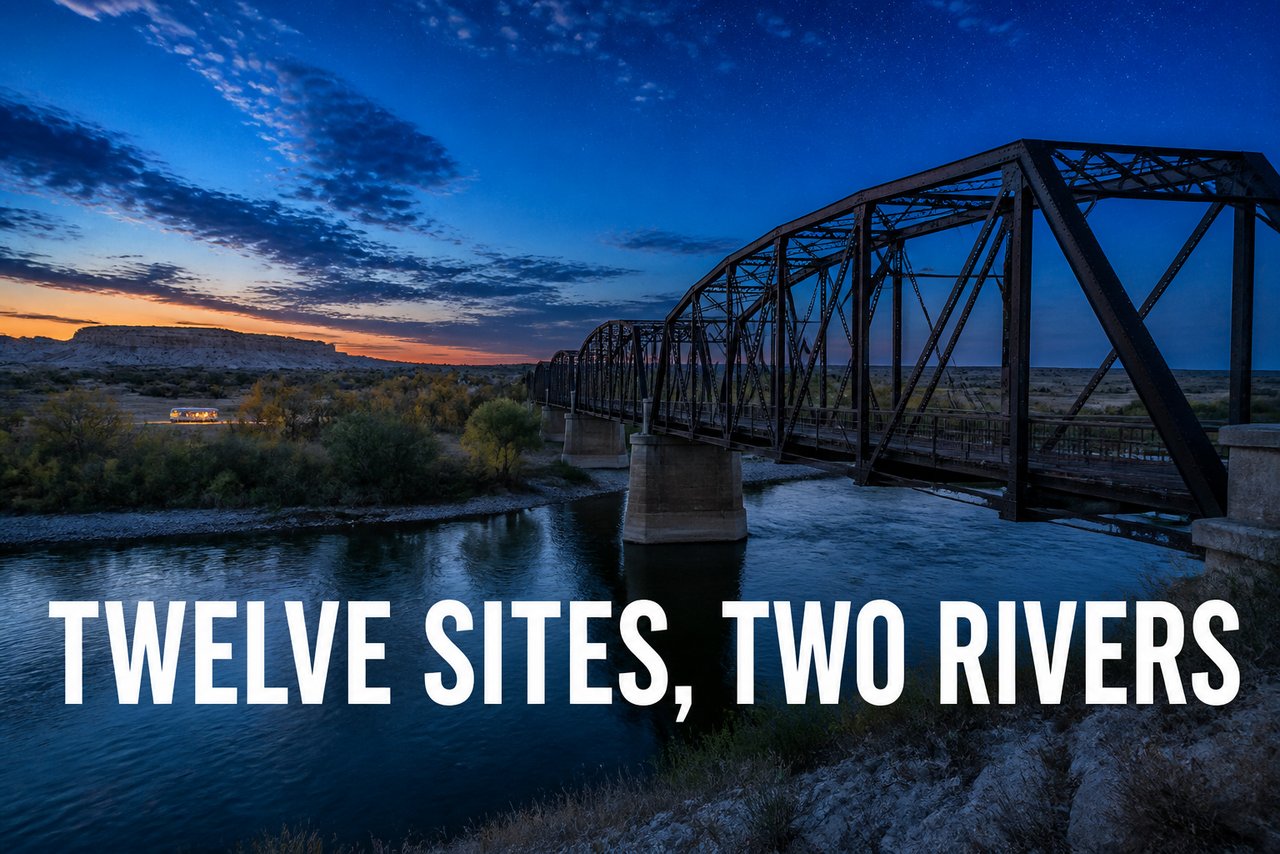
Custer, Montana: Twelve Sites, Two Rivers
There is a Custer, South Dakota, and it is famous. Then there is Custer, Montana - a dot on the Northern Pacific line where the Bighorn River gives up its name to the Yellowstone - and it is exactly the kind of place we love to camp: quiet, historic, and completely unpretentious. We pulled in on July 7 after a great stretch with family, and we had a twelve-site campground almost to ourselves. We were, in fact, the only rig there.
The Campground Story (Every Rig Has One)
Every camping trip produces one small adventure that becomes a story, and ours was a hose bib. The spigot at our site had frozen over the winter and never been replaced, so water duty meant running a hose over to the next site to fill the tank. It was an old-fashioned solution to a modern problem, and it worked fine. The campground's small restaurant came well-reviewed - we made a point to try it before we left, because a diner in a town of a few dozen people on the Yellowstone always has stories on the menu along with the food.
Two Rivers
We spent a day hunting public access to the Yellowstone River, the longest undammed river in the lower forty-eight. What we found instead was its character: rocky bluffs standing over the flood plain, cottonwood groves, and no easy way down to the water - the Yellowstone keeps its distance. But the drive led us to the Bighorn River before it meets the Yellowstone, and we got our pictures: the slow brown water, and an old iron truss bridge standing over it, a piece of railroad-era engineering still doing its job a century on.
The summer storms rolled through on the plains schedule - lots of wind, some rain, and no hail, which mattered, because the Billings area to our west was getting hammered. We watched the cells build and pass from the relative calm of the valley, the way the old homesteaders must have, with one eye on the sky.
The History Under Your Feet
Custer, Montana was born with the Northern Pacific Railroad in the 1880s, a supply point on the line that crossed the Yellowstone here. The town carries the name of the general who met his end just north of here in 1876, and the surrounding country is deep in the story of the Great Sioux War. But the town's own darkest chapter came in 1938, when floodwaters from a cloudburst scoured Custer Creek and took out the bridge under an eastbound Northern Pacific passenger train - the worst rail disaster in Montana history, and the reason modern crossings here are built with flood memory in mind.
And just up the highway is Pompeys Pillar National Monument, the 150-foot sandstone monolith where William Clark climbed on his way back east in 1806 and carved his name and date into the rock - the only surviving on-site physical evidence of the entire Lewis and Clark expedition. Standing where Clark stood, looking at a signature two centuries old, is one of those rare moments when the past feels close enough to touch.
Why Custer MT Works
You come here to slow down. Twelve sites, big sky, two rivers, and enough history in a thirty-mile radius to fill a week. We stayed three days, and it was the quiet reset we needed between the family reunion and the battlefield to come.